Do fences make good neighbors?
Do good fences make good neighbors?
for Methow Home 2024
Submitted by the Methow Conservancy
The old adage that good fences make good neighbors might not always hold true. Sure, sometimes a good fence is just what is needed to keep livestock out of sensitive habitat or to keep the neighbor’s dog from digging in your garden. But sometimes, removing unnecessary fencing is the best way to care for your neighborhood.
Derelict barbed wire, in particular, can be especially pesky and even deadly. Since entrepreneur Joseph Glidden first filed a patent for mass-produced barbed wire in 1874, countless wild animals and birds have been killed by encounters with barbed wire.
Today, an estimated 620,000 miles of barbed wire crisscross the American West: enough to reach the moon and back, with a handful of quick wraps around the earth to boot.
The Methow Valley is no exception to barbed wire’s knotty legacy. Although there has been no recent comprehensive fencing survey in the Methow Valley to provide data, anyone who has ever traveled the back roads, trails, and fields is aware that this valley, too, was once and continues to be delineated by a web of wire.
With the purchase of the Sunny M Ranch, the Methow Conservancy became the owner of hundreds of acres of agricultural land and the miles of fencing that have for generations prevented horses and cattle from accessing crops or disturbing sensitive habitat areas. Some of the fencing remains essential, but much of it is no longer necessary.
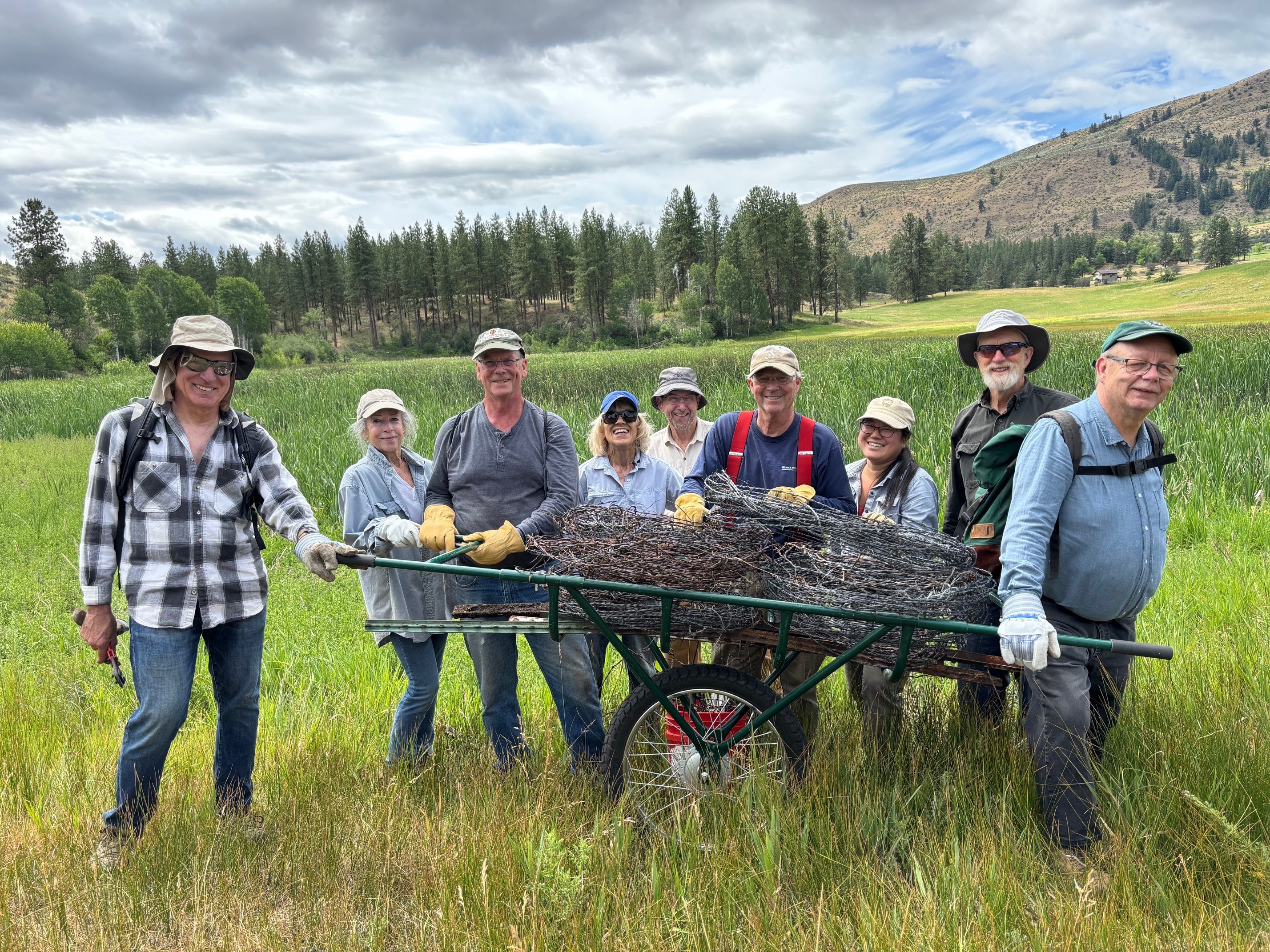
As part of our ongoing fencing inventory on the Sunny M, we have been working with volunteer crews to remove sections of unneeded fencing, partly in pursuit of cleaning up debris, but mainly as an essential component of our commitment to wildlife and their habitat. The Sunny M Ranch is home to hundreds of species of mammals, birds, and amphibians, including large, wide-ranging species whose movement patterns and access to food and water is jeopardized by barbed wire. Removing this wire frees up wildlife passage considerably, especially for the charismatic megafauna.
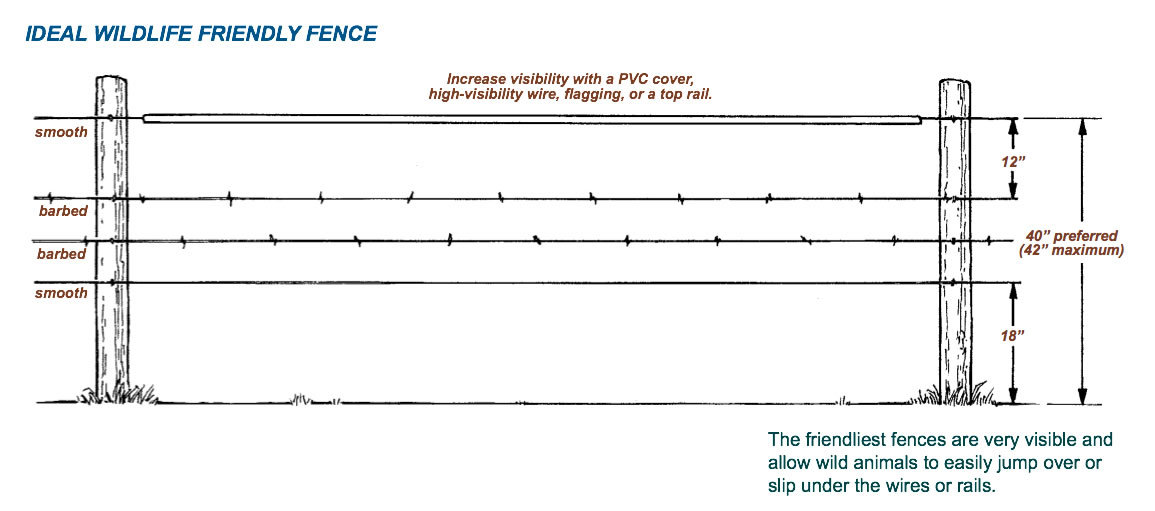
When fencing is necessary—such as a means of keeping domesticated animals out of ecologically sensitive areas or cultivated fields—we are working with a fencing professional to replace standard barbed wire with wildlife-friendlier options, which are still effective at keeping cattle or horses in (or out), but which give wildlife access to breeding and birthing grounds, seasonal habitat, and water sources.
Along boundaries of neighboring properties with limited livestock use, we’ll use a 3-strand smooth wire fence design, which allows for easy wildlife passage. Finally, we will install extra gates in our fencing, to be left open in the winter when there are no livestock to exclude from a particular area. That way the wildlife can just walk through the open gates and not have to wriggle under or jump over the livestock-exclusion fencing.
We hope to use fencing removal and wildlife-friendlier fencing on the Sunny M Ranch as a model for other community efforts, to inspire those with derelict/unused fencing to pull it out, and those with necessary fences to begin converting to fencing that is designed and installed according to some suggestions from Wild Aware Barbed Wire Warriors (wildaware.org/barbed-wire-projects) via Colorado Parks and Wildlife (cpw.state.co.us/).
When fencing is necessary, it should:
- Be highly visible to ungulates and birds;
- Allow wildlife to jump over and crawl under;
- Provide wildlife access to important habitats and corridors;
- Have a top rail height of 42” or less;
- Allow at least 12” between top two wires;
- Allow at least 16” between bottom wire and ground.
We are inspired by other communities where large-scale wire removal projects have been successful due to citizen engagement. The Jackson Hole Wildlife Foundation, the Oregon Desert Natural Association, Wild Aware, and others are helping inform our strategy.
As we learn more about wildlife-friendlier fencing efforts, and as we build our team of volunteers trained in barbed wire removal, we hope you’ll join us on the journey.